Kimi Antonelli Rookie Cards: What Actually Counts
Which Kimi Antonelli cards are true F1 rookie cards, why his 2023–24 F2 issues aren't, how to verify an RC before you pay rookie money for one, and how to spot fakes.
Shop Kimi Antonelli cards on eBay
Live listings — rookies, autos, and graded slabs, updated by the second. Always check real sold comps before you buy.
Live Kimi Antonelli Listings On eBay Now
LIVELive eBay listings · prices and bids as eBay shows them now · tap a card to open it on eBay
“Rookie card” is the most expensive phrase in this hobby, and it’s the one buyers most often get wrong. For a driver like Kimi Antonelli — full name Andrea Kimi Antonelli, the Italian born in 2006 who took the Mercedes-AMG Petronas seat Lewis Hamilton vacated for the 2025 season — there are cards from three different eras in circulation, and only one of those eras produces a genuine F1 rookie card. This page is the reference for telling them apart before you pay rookie money.
What actually makes a card a “rookie card”
The working definition collectors and price guides use: a rookie card is a player’s card from a fully licensed, widely distributed set issued in their first season at the top level of the sport. Three conditions, all of which have to hold.
Formula 1 adds a wrinkle that trips up collectors coming from baseball or basketball: there is no draft. In the US sports, the rookie designation tends to attach to a signing or draft class. In F1 it follows the thing that’s actually visible — the driver’s first season racing in Formula 1. A driver can accumulate years of licensed junior-series cardboard before an F1 rookie card of theirs exists at all.
That’s exactly what happened here.
The Antonelli timeline: prospect, rookie, everything after
This is the spine of the whole page. Three eras:
- 2023–2024 — prospect era. Antonelli was racing in the junior ladder (F3, then F2) inside the Mercedes junior programme. Cards from these years exist and are collected, but they are prospect and junior-series issues, not F1 rookie cards.
- 2025 — the rookie year. His first full Formula 1 season with Mercedes. Cards from licensed 2025 Topps Formula 1 products are his true F1 rookie cards. This is the year that matters.
- 2026 onward — later-year cards. Still licensed, still collectible, sometimes commemorating a genuinely big moment. Not rookie cards. No exceptions, no matter how the listing is titled.
A concrete example of that last bucket, because it’s the one people get caught by: the 2026 Topps Now F1 Antonelli “Youngest Ever Consecutive Wins” card #22 is a legitimate, licensed, graded Antonelli card commemorating a real milestone — and it is not a rookie card, because it was issued in 2026. It’s a milestone card, and it should be bought and priced as one. Both things are true at once, and a listing that leans on the word “rookie” to sell it is selling you the wrong story.
How to verify a listing is really a rookie card
Read the card, not the title. Five checks, in order:
- Find the printed year. The copyright year and set name are printed on the card itself, usually on the back. If the listing doesn’t show the back, ask for a photo of it. A seller who won’t show you the back is telling you something.
- Confirm it’s 2025. For Antonelli, that’s the rookie year. Nothing else qualifies.
- Confirm the set is licensed Topps F1. Topps holds the official Formula 1 trading-card licence, so every genuine licensed Antonelli card comes out of the Topps F1 program. A set name you can’t find on this site’s set guides is worth a second look.
- Treat an “RC” stamp as a bonus, not the test. Rookie-designation marks vary by product line and year and aren’t applied uniformly across every Topps F1 release. The printed year never varies.
- Ignore keyword stuffing. “Rookie” appears in listing titles for prospect cards, later-year cards, and outright customs. It is a search term, not a certification.
Where his 2025 rookie cards actually live
Once you’ve established the year, the question becomes which product — and that runs from pocket money to trophy case:
- Topps Chrome Formula 1 base #8 — the cheapest card carrying his RC mark. Chrome is the F1 program’s base set; there is no paper flagship beneath it.
- Topps Chrome Formula 1 — chromium stock, where the refractor rainbow and the numbered parallels live. Most rookie-card money sits here.
- Topps Chrome F1 Sapphire — the online-exclusive chromium edition, with its own separate parallel run.
- Topps F1 Turbo Attax — mass-market game packs; the cheap, kid-friendly rookie-year entry.
- Topps Dynasty Formula 1 — ultra-premium, built around on-card autos and relics. The top of the rookie market.
- Topps Now Formula 1 — print-to-order cards tied to specific race moments. A 2025 Topps Now card is rookie-year; a 2026 one isn’t.
If a colored or numbered parallel is what you’re chasing, read refractors and parallels explained first — the colour name in the title tells you far less than the serial stamp on the card. For which specific cards to target and how to search them, see the rookie cards buying guide.
Prospect cards aren’t a mistake — just price them correctly
None of the above means his 2023–24 junior-era cards are junk. Buying a driver before the F1 seat is how early collectors get in ahead of the crowd, and prospect cards have their own following. The failure mode is only ever the same one: paying rookie-card prices for a prospect card because a listing title said “rookie.”
Know which one you’re buying, then check sold comps for that card — not for the rookie.
Spotting fakes and unlicensed cards
A rising driver attracts bad actors. The defences:
- Buy graded (PSA, SGC, BGS) for anything at a serious price. The slab certifies condition, authenticity, and the exact card — year and set included.
- “Custom” and “art” cards are not licensed Topps cards. They flood F1 searches, they’re trivially printable, and they have essentially no resale market.
- Scrutinise autographs. Prefer certified, on-card signatures from licensed products. Be sceptical of uncertified autos regardless of how good the story is.
- Check the seller — strong feedback, clear photos of the actual card rather than stock images, and pricing that makes sense against sold comps.
- Filter to Sold listings. Asking prices are fiction until somebody pays them.
Condition and grading, before you send anything off
Rookie cards live or die on condition, and the grade gap is where the money is. Two things to do before you pay a grading fee:
- Measure the centering. Run it through the free card centering tool — centering is the most common reason a card that looks mint comes back a 9.
- Check the economics. The grading ROI calculator will tell you honestly when the fee eats the upside, which on a mid-tier rookie it frequently does.
And because his rookie cards are chromium rather than paper, expect them to grade hard: edge chipping, silvering, and surface hairlines are all much more visible on a Chrome or Sapphire rookie than on a paper card.
Two ways in
If you want a specific rookie — the Chrome base card #8, a numbered Chrome refractor, a graded slab — target-buy the single on eBay using the live listings above. You see the year, the set, the serial, and the grade before you commit.
If you’d rather open cardboard, the LOADED! PGI-10 F1 Collector’s Box is a repack-style box of Formula 1 rookie and prospect-era cards spanning the modern grid — Verstappen, Hamilton, Piastri, Antonelli. Treat it as entertainment rather than an Antonelli guarantee: chasing one specific rookie by ripping sealed product is almost always the expensive route.
Those are the two extremes. In between sit five actual routes into an Antonelli collection — Chrome, Sapphire, Topps Now, Turbo Attax, Dynasty — each with a different entry cost and a different thing it’s good at. The collecting map lays them out side by side and helps you pick one deliberately instead of buying whatever the algorithm shows you first.
Is it a smart buy?
We won’t tell you yes or no — that’s speculation, and honesty is the point of this site. What we’ll say plainly: Antonelli is at the very start of his F1 career, so his cards are a bet on a career arc rather than a settled blue-chip, and values move sharply around results and season milestones. Collect what you genuinely like, size your spending accordingly, and lean on live sold comps over anybody’s quoted number — including ours.
Where to go from here
Depending on what you came here to settle:
- You’ve decided you’re buying, but not what. The collecting map is the strategy page — six routes into a collection (none of them a paper flagship), what each one costs to enter, and which collector each suits.
- You know the route, you need the cards. Which rookie cards to target names the specific 2025 issues worth chasing and how to search each one.
- You’re trying to work out what something’s worth. What actually drives his value covers the two axes — card type and grade — and points you at live sold comps rather than a number that goes stale.
- You’re chasing shine. Refractors and parallels explained is the reference for reading a serial stamp; autographs and chrome is the high end of the market.
- You want to buy at release rather than on the secondary market. The F1 release calendar tracks what’s shipping and when, which matters here because the year printed on the card is the whole test.
And if you want the driver’s own story and season context behind all of this, that’s the Kimi Antonelli hub.
Recommended Products for This Guide
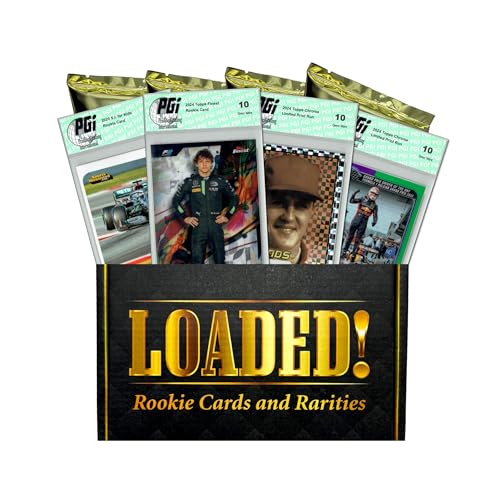
LOADED! Formula 1 F1: 4 PGI Rookie Cards & SPs - Verstappen, Hamilton, Kimi | 4 Graded F1 Trading Cards, Graded PGI 10 & Sealed, Gorgeous black & gold flip-top box, Amazing gift for Racing fans!
LOADED! PGI 10 Formula 1 F1 Collector's Box Rookie Cards & Rarities - Max Verstappen, Lewis Hamilton, Michael Schumacher, Oscar Piastri, Kimi Antonelli. Rookie and prospect-era Formula 1 cardboard — the base of any driver collection.
- First-year / prospect cardboard
- Topps Formula 1 program

2026 Topps Now Formula 1 Kimi ANTONELLI F1 Youngest Ever Consecutive Wins Card #22 - Graded GEM Mint 10
1 owner reviews
2026 Topps Now Formula 1 Kimi ANTONELLI F1 Youngest Ever Consecutive Wins Card #22 - Graded GEM Mint 10.